To a Foreigner, "Main Branch," "Station Branch," and "2nd Branch" All Look Like the Same Shop
I was in Seoul one day and noticed a foreign traveler standing still with Naver Map open on her phone. I tend to be the kind of person who can't help offering help to strangers, so I walked over. She was trying to find a famous Korean café, but the search results showed five or six places with almost identical names. The main branch, the Gangnam Station branch, the Hongdae 2nd branch, the Seongsu branch, and one inside some shopping mall. She looked at me and asked, "Are these all the same shop?"
Yes and no. They share the same brand, but the menu, atmosphere, and operating hours can all be different depending on which one you walk into. A Korean person knows this almost without thinking. But for a foreigner staring at five or six search results, there's no obvious way to decide which one is the "real" one. I ended up explaining for quite a long time.
This kind of moment looks trivial, but it actually reveals the most fundamental difficulty foreigners face when using a map app in Korea. People usually explain the difficulty by pointing to language — Hangul, the lack of English. That's partly true. As of 2026, Naver Map does support an English interface to some extent, but not every business listing is smoothly translated into English. Still, the real problem comes after that. Even when the language barrier is mostly solved, foreigners keep getting stuck. Why?
Honestly, I think the answer is simple. The problem isn't that Naver Map is hard to use. It's that the way places are organized and described in Korea is built around what Koreans intuitively understand.
We Koreans interpret the suffix attached to a shop name almost unconsciously. If you see "본점" (main branch), that's the original store, usually with the widest menu. "역점" means it's inside or right next to a subway station — convenient, but often cramped. "OO몰점" tells you it's inside a department store or shopping mall, so its hours follow the building's hours. "2호점" or "분점" (branch) might have a slightly different concept from the main store. Nobody teaches us any of this. We just grow up knowing it.
A foreigner has to decode all of this one by one — and all at once, on a single search results screen. Which one is the main store? What does "역점" mean? Why do shops with the same name have different ratings? Every one of these judgments has to happen either before the trip or in the middle of it. It's not that there isn't enough information. The opposite is true: there's a lot of it, but the filter that a Korean has automatically running in their head simply isn't there.
The same mismatch shows up in reviews. Korean reviews tend to focus on taste, price, wait time, atmosphere, and interior. For someone with a normal amount of dining experience in Korea, that's plenty. But foreign travelers are curious about different things. Is there a menu in my language? Can I pay by card? Is the kiosk Korean-only? Is it awkward to come alone? Even with hundreds of reviews, the information a foreigner actually needs often isn't in there.
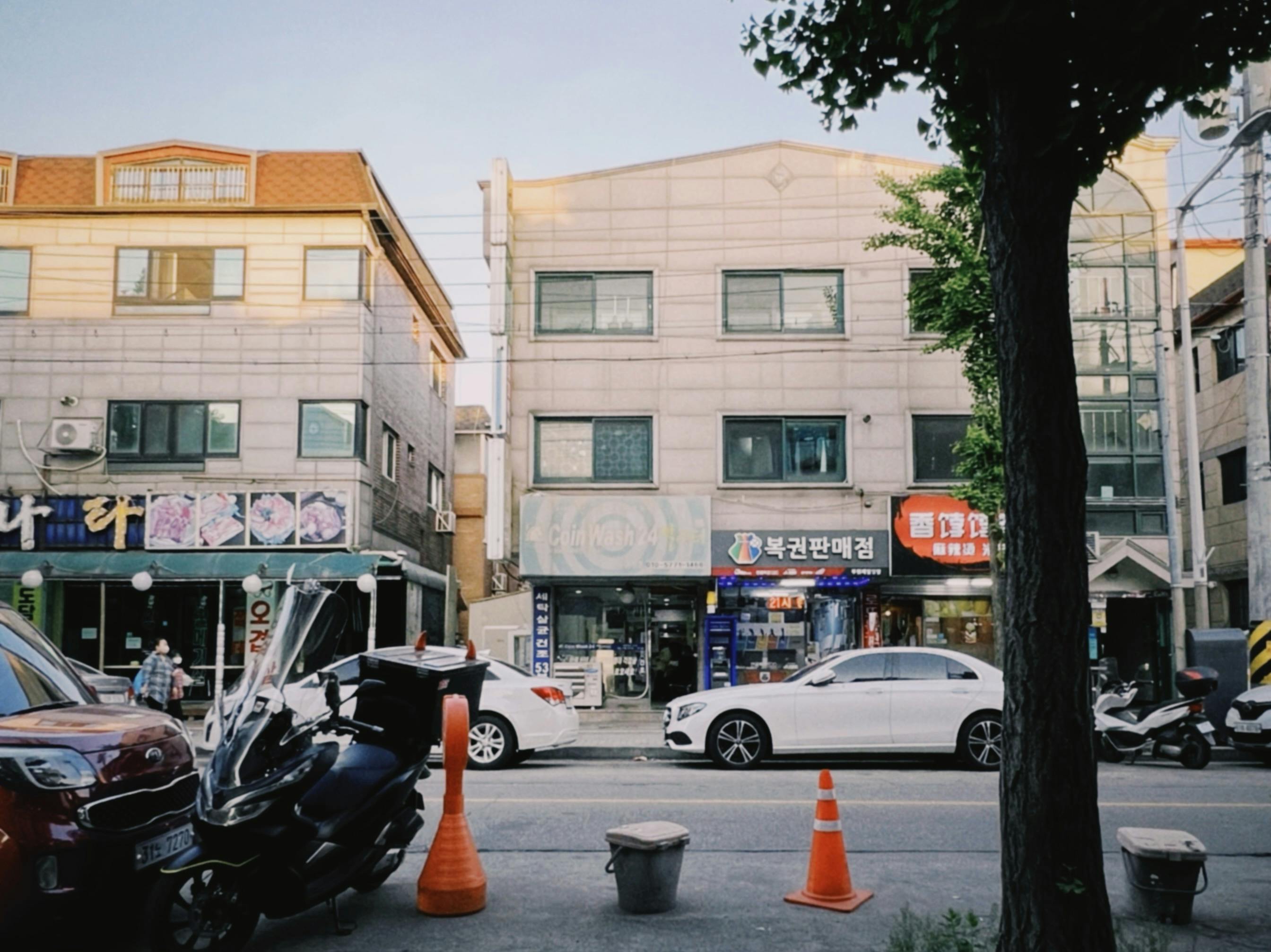
Here's another point that catches people off guard: Korean shops aren't always on the ground floor facing the street. They might be in a basement-level food court, on the 4th floor of an office building, in a converted house down a back alley, or in a tiny booth inside a mall food court on the 6th floor. Koreans look at an address and can already guess "ah, this is inside a building." A foreigner reading the same address has no way of telling whether it's a freestanding building or one unit inside a tower. So even after arriving at the spot, they pause again: "Is this really it?"
Operating hours work the same way. When a Korean sees "11:30–15:00, 17:00–22:00," we immediately understand the gap is a break time. To a foreigner, it's unclear at first — are those two separate schedules? Does the shop close in the middle? Is lunch a different restaurant from dinner? Last-order times are the same kind of buried information.
So if you want to get stuck less often on Naver Map as a foreigner, the faster path isn't learning the app's features — it's learning the order in which to check information. Based on what I noticed while helping that foreigner in Seoul, here's what I'd suggest.
First, copy and paste the Korean name of the shop directly, instead of searching in English. Korean businesses often don't have a standardized English spelling.
Second, always check the branch name. Decide between the main branch, the station branch, and the mall branch before you set out.
Third, look at the nearest subway station and exit number rather than the street address. In Korea, that's the more intuitive landmark.
Then there are the photos. Even when checking interior photos, try to look at ones uploaded within the past month. Korean shops change their interiors, entrances, and signage more often than you'd expect — relying on old photos can actually leave you unable to find the place.
Lastly, the hours. If you see "11:30–15:00" followed by "17:00–22:00," that gap is almost certainly a break time. And the last-order time can be 30 minutes earlier than the closing time on top of that.
In the end, what's hard for foreigners isn't Naver Map as an app. It's the fact that the information the app shows is built for Korean users. You can't solve it by switching to a different tool. You can only solve it by learning, just one layer deeper, how Korean places get categorized and described. And that's something worth knowing — for foreign travelers, and for the Koreans who end up guiding them.