Why Lunch Spots in Japan Won't Take Your Card — And How Much Cash to Pack Each Morning
Whenever I head to Japan, I always exchange my entire travel budget into cash. I tend to use cash over card. There's the old idea that Japan is a cash-based country, and on top of that, some places really do refuse cards. It's also one less thing to worry about — no card loss or fraud anxiety.
But every Japan trip has this one recurring puzzle for me. Every morning at the hotel, the same question: "How much cash do I bring out today?" Bring too much and it's a hassle to lug around. Bring too little and you're standing in a ramen shop at lunch, hearing "cash only please," and scrambling.
What makes this genuinely strange is that the policy isn't even consistent within a single shop. Some places take cash only at lunch but accept cards at dinner. I looked into why, and Japan has its own particular reasons for this. So I put it all together. Hopefully this helps the next time you're packing cash before heading out of your hotel in Japan.
"Japan = cash society" is only half true
It used to be all cash, apparently. Finding a shop that took cards was difficult. But things have shifted. In central Tokyo, Osaka, and Kyoto these days, it's actually rarer to find a shop without a PayPay sticker on the door. Rakuten Pay, d-pay, MerPay — QR payments are everywhere.
Convenience stores, drugstores, and chain restaurants take cards just fine. Chains like Sushiro, Matsuya, and Yoshinoya accept cards and QR payments at any time of day.
So the blanket "Japan is cash only" idea is outdated. But there's an exception zone, and it's important. Lunch specials and small neighborhood restaurants. Just to be safe, bring both card and cash — that way you avoid most awkward situations.
So why is lunch cash-only?
Here's the core of it. The reason the same shop has different policies at different times of day is actually pretty interesting.
Japan's card merchant fees are way higher than Korea's. Korea sits around 1~2%; Japan is more like 3~5%. That's a meaningful weight on small businesses.
Combine that with how lunch specials work in Japan. Lunch menus typically run 800~1,200 yen — cheap on purpose, designed for volume rather than margin. On a 1,000-yen set, losing 30~50 yen to card fees is a huge slice of the margin.
So the move is: cash only at lunch, cards welcome at dinner when the average ticket size rises to 3,000~5,000 yen. Same shop, same owner, just a different policy by time of day. It's one of the more peculiar quirks of Japan's food industry.
How can you tell before walking in?
There are tells on the storefront and menu.
Shops with a ticket vending machine at the entrance are almost always cash. If you see that food-ticket machine, you can pretty much guarantee it. Most of these machines have no card slot built in. Some newer models accept cards and QR, but they're rare.
A PayPay or Rakuten Pay sticker on the menu or door means QR payment works. Japanese payment stickers have a clean visual style, so they're easy to spot. If you see those, cards usually work too.
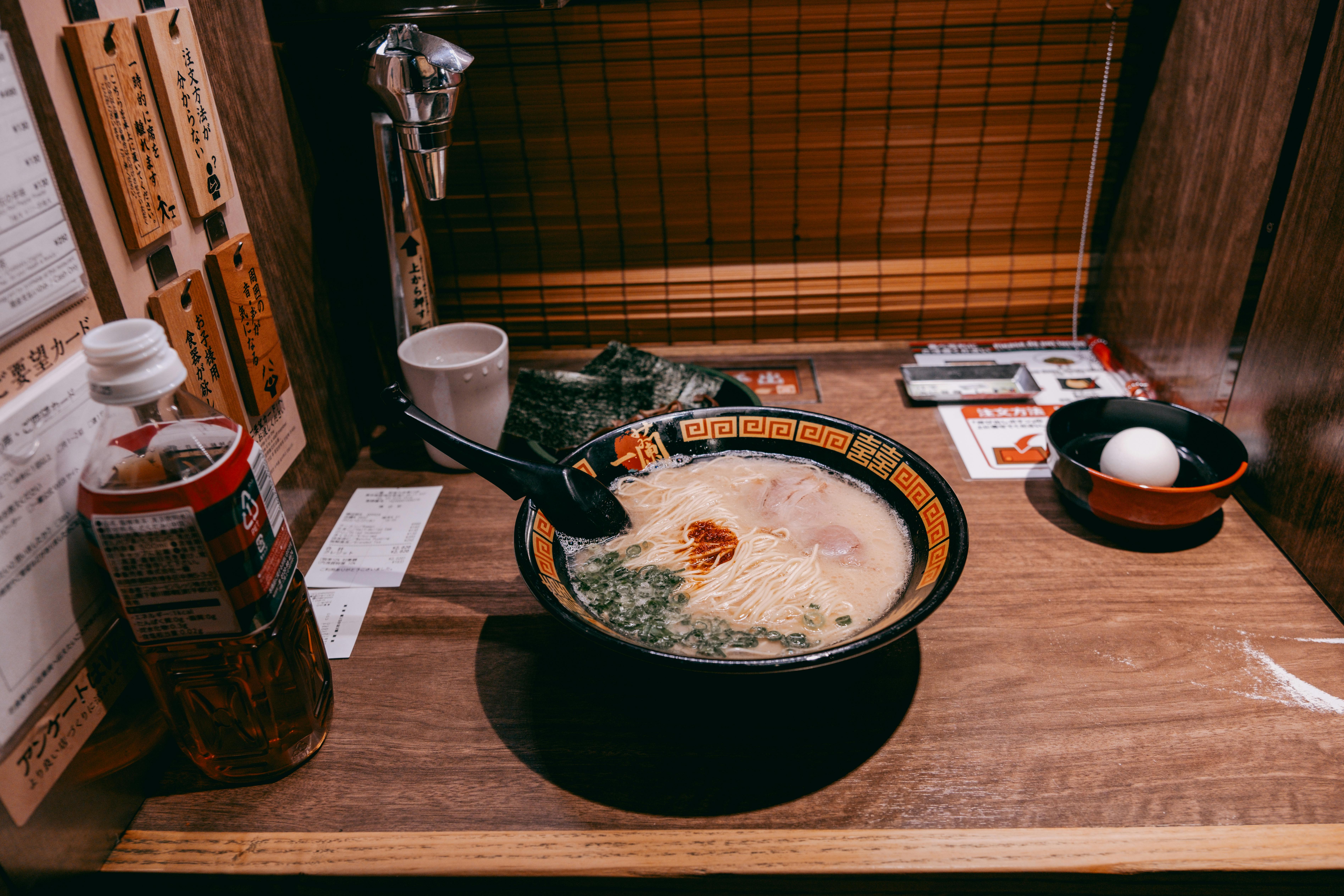
Ramen shops, set-meal places, soba shops, and udon shops tend to be cash-only at lunch. Especially the small ones tucked into back alleys. Restaurants on main tourist streets behave differently, but once you walk a block away, the rules change.
Chain restaurants accept cards anytime. Sushiro, Kura Sushi, Matsuya, Yoshinoya, Katsuya, Saizeriya — these all take cards and QR at lunch or dinner.
Finally, Google Maps reviews are a great signal. Search in Korean for the restaurant name and you'll often see "cash only" comments. If you've already picked your spot, give the reviews a quick scan.
So how much should you pack before leaving the hotel?
This is really the heart of it. The question every morning.
For central Tokyo, Osaka, or Kyoto, 5,000~10,000 yen a day is usually enough. Card and QR work plenty of places, so cash mostly goes to lunch, small restaurants, vending machines, and shrine admission.
For smaller cities and rural areas, pack more — 15,000~20,000 yen. Smaller towns have fewer ATMs and a higher share of cash-only restaurants. When I went to Yonago, I made a point of carrying more cash than I would in a major city.
If you have meals planned, add the cost on top. Plan for a 1,000-yen lunch and a 3,000-yen dinner? Add 4,000 yen of buffer. Cafés and dessert spots in smaller neighborhoods can be cash-only too, so leave 1,000 yen of slack there.
If you run short, pull cash at an AEON ATM with your Travel Wallet card. Withdrawals come in 1,000-yen increments, so you can grab just what you need. The exchange rate beats currency exchange counters, and there's no fee — which is why a lot of people now exchange a small amount in Korea and just withdraw as they go.
I personally carry 10,000 yen for city days and 15,000 yen for small-town days. If I run low, I just hit an ATM. With that cushion, "cash only please" never throws me off.
To wrap it up
Japan isn't fully a cash society anymore. Cities are mostly card- and QR-friendly. But lunch specials and small neighborhood restaurants are the exception, and that's the part that catches Korean travelers off guard every time. Ticket vending machine at the door = cash. PayPay sticker = card OK. Those two checks alone cover most situations. And bring 5,000~10,000 yen in big cities, 15,000 yen in smaller towns, and you'll move around without stress.
If you run short, you can just top up at an AEON ATM, so there's no need to overpack and carry everything from the start. Hopefully this helps if you've ever stood at your hotel in the morning wondering how much cash to take out for the day.